Categories
Uncategorized

Marcel Duchamp, the Funniest Man in the Museum

I have always liked art that made me laugh. For years my favorite art joke was René Magritte’s pipe, the painting of a perfectly ordinary pipe with the words “Ceci n’est pas une pipe” written underneath. This is not a pipe. And of course it is not. It is a painting of a pipe. You cannot smoke it. The joke is that the image of a thing is not the thing, and Magritte makes you laugh your way into a genuinely slippery idea about representation.
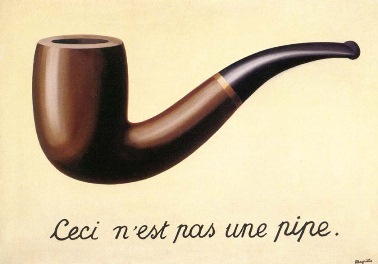
René Magritte, The Treachery of Images (This Is Not a Pipe), 1929. Los Angeles County Museum of Art. View at LACMA

But I have a new contender for the most absurd and most canonical art joke ever made. Marcel Duchamp took a cheap postcard reproduction of the Mona Lisa and drew a mustache and a little goatee on her. That alone is funny, defacing the most worshipped painting on earth with a doodle. But the title is the better joke. He called it “L.H.O.O.Q.” Read those five letters aloud in French and they spell out the phrase “elle a chaud au cul,” which translates as “she has a hot ass.” He vandalized the most famous face in art and catcalled her. It’s one of the most important works.
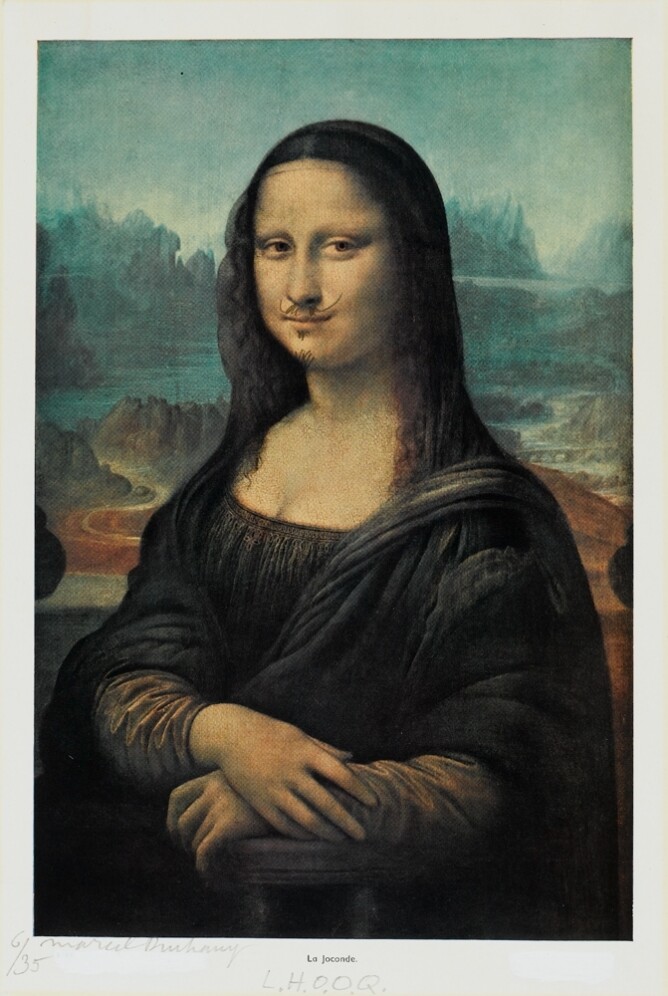
Marcel Duchamp, L.H.O.O.Q., 1919.
View at the Norton Simon Museum

Truly good conceptual art is often funny because it’s creating an entirely different point of view. A good joke pokes at something we take for granted and holds it up at a strange angle. The idea of art, what counts as art and what does not, is not something we normally examine. We just walk into a museum and assume the question is settled. Humor is one of the few tools sharp enough to pry it back open.

I went to the Duchamp show at the MoMA recently and spent most of it laughing, which is something that doesn’t normally happen at this museum. Museums, especially a place like MoMA, are about learning and being serious. They are not really set up for fun. Duchamp gave me fun anyway, and the more I looked the more I understood that he was one of the cleverest minds the art world has ever produced, a genuinely brilliant artist in a way that most artists, even very good ones, simply are not.

There is a photo from this trip I am going to use in my holiday letter. It is my mother-in-law Jeanne and me, standing in front of a urinal and smiling broadly. But this wasn’t any urinal. This was THE urinal. Duchamp’s Fountain, the porcelain one he bought in 1917, tipped onto its back, signed with the fake name “R. Mutt,” and submitted to an art exhibition as a sculpture.

Here is the thing. I never actually knew much about Duchamp. I knew about the urinal, of course. Everybody knows about the urinal. But I did not know much else, and what surprised me first was the most basic fact of all. Duchamp could really paint. As a teenager he made the kind of careful, pretty pictures that get a fifteen-year-old praised by his teachers. By his twenties he was deep into Cubism, and then he painted “Nude Descending a Staircase,” which scandalized people who showed up expecting a nude and got what looked like a robot falling down some stairs. He could have spent forty years being a respected painter. Instead he put the brush down and started asking a much deeper question about art. What if the idea is the art, and the object is almost beside the point?

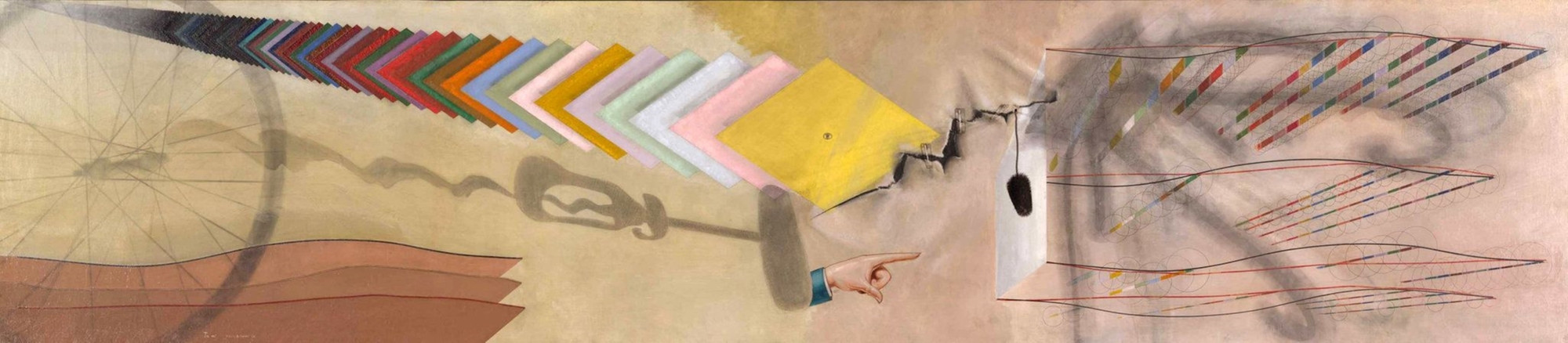
You can see him chewing on that question even in the paintings. His last painting on canvas is a long, strange picture with a painted tear running down it, and over the tear he stuck real safety pins, as if the canvas had ripped and somebody had mended it with whatever was in the kitchen drawer. He also brought in a commercial sign painter to add a pointing hand, and then had the sign painter sign that part of the work. So the painting is partly painted by a hired tradesman who gets his own credit on the canvas. It is a painting that quietly mocks the idea of the painting, and it already has the readymade idea hiding inside it.

Marcel Duchamp, Tu m’, 1918.
Image from Moma of Painting from Yale University Art Gallery

That idea ran through everything he did next. He would take an ordinary manufactured thing, a snow shovel, a bottle rack, a urinal, give it a title, and declare it art. No carving, no painting, no technique. The work was the decision. You can feel the establishment recoiling, and you can almost hear him asking, sweetly, “why not?” If you stand in front of Fountain and find yourself saying “that is not art,” congratulations, you’re participating in the conversation that Duchamp wants to have with you.

And that was the plan from the start. When he submitted “Fountain” in 1917, it went to an exhibition that had promised to show every work that was entered, no jury, no rejections. They rejected it anyway. They hid it during the show and refused to display it, which is precisely the reaction Duchamp was fishing for. He had not made a urinal beautiful. He had set a trap. He wanted the gatekeepers to look at an ordinary object he had chosen and called art, and to blurt out “no, that is not art,” so that everyone would suddenly have to ask the question out loud. What is art? Who decides? The rejection did not ruin the piece. The rejection completed it.

Including these readymades in the MoMA show was difficult. The show has a whole room of them, and almost none of them are originals. They are copies, replicas Duchamp authorized decades later. The reason is simple and a little wonderful. When he first made these things he was an impudent young man, around thirty, and nobody thought any of it mattered, including the people closest to him. The original Fountain was lost. The first bottle rack and bicycle wheel got thrown out, in some cases by his own family doing the sensible thing with what looked like junk. So the artworks that detonated the twentieth century survive mostly as second and third versions, made later, once the world had decided the joke was important after all. There is something perfect about that. The objects weren’t the point, the ideas were.

He kept finding new ways to create transgressive art. He invented an alter ego, a woman named Rrose Sélavy, and had the famous photographer Man Ray take pictures of him in character. The name is a pun. Say it in French and it sounds like “Eros, c’est la vie,” love is life. So the joke runs at least three layers deep, the costume, the name, and the wordplay hiding inside the name, and he is doing all of it with a completely straight face.

When he was escaping from Europe from the war he created the most beautiful miniature copies of his art. For his museum in a box project, he made little suitcases packed with tiny reproductions of his own work, a portable one-man retrospective you could carry around like a salesman’s sample case. And the miniatures are genuinely beautiful, made with real care. The audacity is the timing. He was assembling his own retrospective before he had really had the exhibitions that would earn one. He was curating his own legacy as a joke and as a fact in the same gesture.

When we look at someone like Duchamp now, we tend to see him through the people who came after, the ones who took his moves and turned them into a familiar, almost ordinary kind of art. Stand in front of a urinal in a gallery and it is easy to think of Andy Warhol and the soup cans. But Warhol never makes the soup cans without Duchamp going first. The imitators arrive and copy the discovery so many times that many of us never fully understand it. What was once revolutionary becomes wallpaper.

Jeanette Winterson, in her book Art Objects, writes that “The most conservative and least interested person will probably tell you that he or she likes Constable. But would our stalwart have liked Constable in 1824 when he exhibited at the Paris Salon and caused a riot? . . . To the average eye, now, Constable is a pretty landscape painter, not a revolutionary who daubed bright color against bright color ungraded by chiaroscuro. We have had 150 years to get used to the man who turned his back on the studio picture, took his easel outdoors and painted in a rapture of light. It is easy to copy Constable. It was not easy to be Constable.”

Duchamp was a real philosopher of art, sitting alongside the other brilliant minds who have changed how we see, and he did his philosophy through transgression. Plenty of people are funny. Cartoonists are funny, comedians are funny, the person who first drew a mustache on a poster was funny. Duchamp went much further than funny. He used the joke the way a philosopher uses a thought experiment, to corner you into a question you cannot wriggle out of. When Wittgenstein asks what we really mean by a word, or Descartes asks how he can be sure he is not dreaming, the move is the same one Duchamp makes when he sets a urinal on a pedestal. Each of them takes something you thought was obvious and shows you that you never actually examined it. The urinal is an argument. So is the mustache. He just made his arguments out of porcelain and pencil instead of prose.

That is the heart of it, I think. Art is supposed to surprise you and then make you think, and Duchamp understood that a good joke does both at once, faster than any sermon. He spent a whole career proving that the most serious idea in the room can walk in wearing a clown nose. Jeanne and I have the photo to prove we fell for it, grinning in front of the most famous toilet in the world.

Note: I came across a piece (which I haven’t read yet) that seems similar.

Categories
Uncategorized

The Dizziness of Freedom

I played weekend soccer in elementary school. Though I was far from the best player on the team, I was the fastest kid on the field. That meant I’d sometimes end up on a breakaway, with the ball at my feet and no defenders ahead of me. When that happened, I’d fall down. I’d literally laugh and fall down, and I wouldn’t even try to kick.

Now, decades later, I realized what I was doing. My body was sabotaging itself. The laugh came first, then the legs going soft, then the grass.

This was a reflex. If I had thought about it, I would have had plenty of options. I could have practiced it, until my body knew what to do when the moment came in a real game. But I wasn’t thinking. Underneath the not-thinking was a fear I couldn’t have named at the time. It was a fear of making a decision, and possibly failing.

I thought I didn’t deserve to score. That was the fear underneath, and the usual advice only made it worse. “Fake it till you make it” sounded selfish, a way of saying “I don’t know what I’m doing, so please bear with me while I figure things out.” But the real selfish act is sitting with your own insecurity so long that you forget there’s a job in front of you that needs doing.

Alfred Adler, the great psychologist from the early 20th century, had a word for how to think about this: Gemeinschaftsgefühl. It’s a German word that loosely translates to “community feeling.” The idea is that we’re here to contribute to something larger than ourselves. We are here for the benefit of others, not ourselves.

I have one friend who’s genuinely curious and warm, and asks people good questions. But when a conversation gets into really interesting territory, where something ambiguous or tender is sitting on the table, she laughs. She’s laughing because it’s funny and interesting to her, and also a little uncomfortable. The laugh shuts the conversation down right when it’s getting good. She doesn’t mean it that way, but the laugh does the work of closing a door.

I recognize this because I do versions of it myself. My adult version of the soccer fall is gratitude, both giving and receiving. If someone thanks me for something that actually mattered, I feel the reflex start up. I’ll crack a joke or shift the credit to someone else before the moment can land. Giving it is almost as hard. When I want to tell someone what they’ve meant to me, I can feel my body trying to find a lighter, safer version that won’t require me to sit in the fullness of what I actually mean.

The Danish philosopher Søren Kierkegaard had a name for this reflex. Writing in the 1840s, he was one of the first people to treat anxiety as a philosophical problem. He’s sometimes called the father of existentialism, and what he named was existential anxiety, the dizziness of freedom. It’s the intense uncertainty that hits you when you realize the next move is yours, and so is whatever comes of it. That dizziness is terrifying enough that we spend most of our lives trying to avoid this responsibility.

This matters more as I get more senior at work, where people look up to me. Authenticity matters when you’re a leader, because other people are depending on you. The temptation is to talk about the problems rather than trust the company strategy. But that’s its own kind of falling down in the grass. Part of the job is putting on a brave face even when you’re not confident. Your job isn’t to feel brave. It’s to give other people the steadiness they need.

One of my mentors, a former CEO of several companies, told me once, “You don’t have enough time to be an expert in everything. You do it a couple of times and then move on to something new.” It wasn’t advice so much as access. He was showing me that even at his level, he hadn’t figured everything out. Nobody does. There’s no moment when someone tells you that you’re allowed to take the next step. You grab it anyway.

Now I have the chance to do that for other people, and it’s become one of the best parts of my job. Someone I worked with, I’ll call her Nancy, was very competent but had spent a decade without a real chance to grow. She didn’t feel worthy of the space she was taking up. We worked on small things together, starting with how she introduced herself in a meeting. It was a tiny thing, but it was the same kind of muscle memory I needed on the soccer field. I could stand with her as a coach while she did the work.

Immanuel Kant, one of the great moral philosophers of the Enlightenment, wrote that we stay children, and not because we lack reason. We have the reason. What we lack is the resolution and courage to use it without someone else directing us.

Being an adult doesn’t mean the dizziness goes away. It means you learn to manage it. You stop waiting to feel ready and start. I came across a phrase from the Disordered podcast that sums up this whole essay. The hosts were talking about clinical anxiety, but it applies to existential anxiety too. They call it shortening the time between “oh my god” and “oh well.”

Categories
Uncategorized

Mind Like Water

David Allen wrote Getting Things Done in 2001 and became a kind of secular priest for ambitious, overwhelmed professionals. His central claim was almost absurdly simple. Get things out of your head and write them down. He wasn’t just pitching better organization. He was promising you’d feel calmer, think more clearly, and be more present with the people around you. He called the result “a mind like water.”

When I first heard this, I was drowning in work. I tried it, and it made me more relaxed. But I kept wondering why making lists made me feel better. The answer is a simple principle called the Zeigarnik Effect.

Bluma Zeigarnik was a Soviet psychologist. In the 1920s, she was sitting in a Berlin café when she noticed something odd about the waiters. They could hold an absurdly complicated order in their heads while it was still open (twelve people, substitutions, dietary restrictions) and then forget it almost instantly once the bill was paid. She went back to her lab and confirmed what she suspected. We remember unfinished tasks far better than finished ones. The brain treats incomplete work like an open file on your desktop, staying active and demanding attention until it gets saved or closed.

Maria Ovsiankina noticed something similar. Open loops don’t just stay active in memory. We also feel a strong pull to return to them. The Ovsiankina Effect is why it’s so hard to stop in the middle of something once you’re engaged, and why interruptions feel so grating even when they’re minor. We remember the open loop and feel compelled to close it.

And that’s what I notice in myself. Whenever I start a new project, pick up a new book, or start a new text conversation, that’s a new open loop. Often these unfinished things would scream, “Hey! Look at me!” By the end of a busy day, the tiredness I feel isn’t just physical. Every loop I opened and didn’t close is still there, demanding to be dealt with until I do something about them.

That’s why I could get a mind like water just by writing things down. Writing something down closes the loop for a while. My mind can stop circling. The list holds my open loops so my attention doesn’t have to.

The most obvious thing I learned is that the number of open loops matters. Right now I’m reading a book I actually want to finish, and every instinct says to start the other one on my shelf. But if I do, I’ve just added another loop pulling at me from somewhere I can’t quite see. If I really want to finish the first book, the answer is to wait. I’ve made a commitment to the first one, and splitting the loop makes both harder. In the end, the answer is to close some loops before opening new ones.1

When I’m in the middle of something I love, the open loop isn’t a burden. Everything is in alignment, like a brigade of tiny soldiers who were all wandering in different directions suddenly snapping into formation and marching together. My mind is going to be obsessed with this thing anyway. It becomes the single most important thing in the world, and if I do anything else, it’ll just be a distraction. It’s what keeps me thinking about it in the shower, wanting to talk to everyone about it, working on it the moment I have ten free minutes. I’m in a flow state, and the incompleteness is what keeps it going. Then, when the loop finally closes, everything settles into a beautiful harmony—at least for a little while. When I finish a book, it becomes a memory, which is why I try to write about books while I’m still in the middle of them.

The thing I keep coming back to is how much better everything feels when I’m actually inside one thing. Not managing ten things, not half-finishing six of them, just present with one open loop that I care about. I’m trying to keep the loops few and stay inside the good ones. That’s as close to a mind like water as I’ve managed to get.

Footnotes

  1. Software engineering calls this keeping your Work in Progress (WIP) low so one project doesn’t distract from the others. ↩︎
Categories
Uncategorized

The Massage Convert

For many years, I’ve been wrong about massages.

My mistake was that I thought about them scientifically. If it’s worth doing, there should be measurable outcomes. Deep tissue work releases lactic acid. Pressure on trigger points reduces inflammation.

That didn’t work for me. It just hurt, and then hurt a little less, and the whole thing felt expensive and strange and not worth it.

What changed wasn’t the massages. It was me getting better at relaxing. And once I stopped bracing against the whole experience, I started to understand what it actually is.

It’s not a medical procedure. It’s something much more human than that.

Think about the moments when you truly feel pampered. Not just served, but genuinely attended to. A great meal where the waiter anticipates what you need before you ask. A barber who takes their time. A tailor making small adjustments with real care. Another person giving you their full attention, and something in you settling because of it.

A massage is that, taken to its logical extreme. You lie there and surrender completely. Someone spends an hour doing nothing but tending to you, figuring out where you’re tight and working on it. And then there are the oils.

Across every tradition that ever tried to heal the human body, Ayurvedic practice in India, Egyptian medicine, Greek and Roman bodywork, Traditional Chinese Medicine, you find oils. Warm substance applied to skin. The specifics differ. The impulse is identical. Cultures with no contact with each other, no shared language, no reason to coordinate, all arrived at the same answer. That’s not coincidence. That’s something true about what a human body needs from another human body.

There’s a ritual to all of it. The quiet room. The dedicated hour. The ancient map the practitioner is working from. This architecture isn’t decoration — research into how healing works suggests the more ceremonial and physical an intervention, the more powerfully it works. The body registers: something significant is happening here. And it opens.

Acupuncture is a great example of something working even though it’s not supposed to. The studies are genuinely mixed — some show it works, some show that sham acupuncture, needles placed nowhere near the traditional meridian points, works just as well. The scientific community mostly reads that as debunking. But there’s another interpretation sitting right there: maybe the ritual is the mechanism. The needles, the serious attention to your body, the quiet room — maybe that’s what’s doing the work. If sham acupuncture works too, that’s not proof that acupuncture is fake. That’s proof that the ritual is so powerful it doesn’t even need to get the details right.

Reiki takes it even further. It’s a Japanese healing practice where a practitioner places their hands lightly on or just above your body, working with what they describe as life energy. No needles, no oils, no manipulation of tissue. Just presence and intention and the belief that attention itself can do something. Reiki shouldn’t work by any measure. No physical contact, no chemical intervention, nothing you can point to. Which makes it the purest version of the argument. It can’t possibly work through scienc,e yet it still produces results. So it’s probably not the science doing the work here.

I was making the same mistake with massage. Focused on whether it worked, whether it was worth it, whether Vladimir was hitting the right spots. Missing the whole point. The massage didn’t change. I did. I got out of the way of something that was always going to work.

Why did every human culture, independently, land on the same answer? Ayurveda. Egyptian medicine. Traditional Chinese Medicine. Greek bodywork. All of them. Oils, hands, ritual, presence. One person anointing another and saying: for the next hour, this is all I’m doing. Because it works. That’s the whole argument. I get it now. Took me long enough.

Categories
Judaism Uncategorized

Profaning the Sacred

Apologies for posting this on a nonstandard day, but I wanted to post this in time for January 27th, Holocaust Remembrance Day.

The remains of the fire that tore through Beth Israel Congregation, the only synagogue in Jackson, Mississippi in January 2026. 

I’ve been thinking about Kristallnacht—the Night of Broken Glass. It’s a strangely beautiful name for such horror, and the word has actually fallen out of favor in Germany, where people now recognize it as a euphemism that downplays the violence and brutality of the pogroms. They prefer alternative names: Novemberpogrome (November Pogroms) or Reichspogromnacht (Reich Pogrom Night). These names capture the truth more honestly—violence, desecration, a turning point.

A few years ago, listening to a survivor speak at our synagogue, something struck me about that night. Not just its historical significance, but something more fundamental about the nature of evil itself.

The Banality of Evil

The woman who spoke was quite old. She had been a child during Kristallnacht, which means we’re approaching the end of an era when people who actually experienced the Holocaust can speak on their own behalf. Once they’re gone, these events become history—easier to file away, easier to forget the ordinary horror of it all.

She described how people came into synagogues and desecrated the Torah. Synagogues were torched. Torah scrolls were ripped and trampled. Cemeteries were defiled. Jewish books were burned. Jewish men were rounded up and sent to concentration camps.

We like to think that if we had been there, we would have known. We would have seen the evil clearly and stood against it. We imagine we could have explained things to people, made them understand. But the reality is that evil is far more banal than that. It doesn’t always announce itself with horns and pitchforks. It begins quietly, by gradually stripping away their humanity, and what better way of destroying their humanity than destroying the things they hold most sacred?

That’s why the desecration of the Torah hit me particularly hard that day.

From Sacred to Profane

The word “profane” originally means to make something ordinary, to strip away its holiness. I thought about my son when he was two years old, trying to climb into the ark that stores the Torah scrolls in our synagogue. To him, it was just a cabinet—an object with its profane, functional purpose. But to us, it’s sacred space, the holder of our most important text, our connection to thousands of years of tradition and meaning.

Profane also means to violate or treat with contempt. That’s what happened during the Jewish pogrom that night—the systematic profaning of sacred objects, the desecration of things that held deep meaning for an entire people.

When they destroyed the Torah scrolls on Kristallnacht, it wasn’t simply about destroying Judaism or trying to destroy the Jews. When you destroy the sacred objects of a people you’re ripping away their humanity. Once you do that, you can do whatever horrible thing you want to them, because these people are no longer human in your eyes. They’re objects. Worse than objects, actually—they look like humans but you’ve decided they’re not. That’s why the Nazis could do all of these horrible things to the Jews—because we were no longer human.

Where are We Now

Dara Horn captures something devastating in her Atlantic article Is Holocaust Education Making Anti-Semitism Worse? She writes that Holocaust education treats Jewish murder as a universal metaphor instead of honoring Jews who died. The dead Jews of the Holocaust are being used to teach a general lesson on tolerance and genocide—profaning their memories.

She points out that the National Museum of African American History doesn’t end its slavery exhibition by pivoting to “other enslaved peoples throughout history.” That would be insulting. But Holocaust museums routinely do this to Jews, ending with other genocides and generic “upstander” pledges. Jewish experience becomes a metaphor, never something valued for its own sake.

While we talk about the atrocities of the Holocaust, students make “Jew jokes” without stigma. People throw pennies at Jews in 21st-century America. Shopping carts “accidentally” ram someone wearing a kippah. When you set the bar for bigotry at mass murder, most of it doesn’t make the cut.

David Baddiel captures the double standard in Jews Don’t Count. We’ve created a hierarchy of protected minorities, and Jews don’t make the list. Whoopi Goldberg can say the Holocaust “wasn’t about race”—just “white people doing it to white people”—as if Jewish identity doesn’t count. “What should we do about Israel?” has become the new “What should we do about the Jews?” The rhetoric around Israeli “misdeeds against humanitarianism” is eerily similar to the Nazis’ reliance on science—different vocabulary, same structure.

When those men desecrated the Torah scrolls on Kristallnacht, they stripped away Jewish humanity by profaning the sacred. We can’t just teach people about gas chambers and expect them to recognize anti-Semitism—yet that’s exactly what we’re doing. Holocaust education has trained a generation of “upstanders” who will spring into action the moment they see another Holocaust—and do nothing about everything that comes before it. We need to teach the continuum: the constant dehumanization of Jews throughout history and today.

Jews don’t count. Except they should. They must. That’s how we honor both the dead and the living.

Categories
Uncategorized

The Holiness of Numbers

I used to think numbers in Judaism were kind of random. Noah was on the ark for 40 days and 40 nights. The Jews wandered in the desert for 40 years. I thought “There’s no way there were actuaries counting out 40 days.” But then it got worse. I learned that “40” in biblical Hebrew doesn’t really mean forty. It means “a lot.” It’s basically the ancient equivalent of “umpteen.”

This made me feel like religion wasn’t scientific at all. The whole thing felt parochial and naive. Clearly, the ancient Jews didn’t understand numbers as well as we did.

But recently I’ve had a change of heart. It’s not always about mastering mathematics and bending numbers to our whims. It’s about taking the profane (which is a more colorful word for ordinary) and making it holy.

When Numbers Were Holy

We live in a world where we’ve domesticated numbers. We’ve made them perfectly obedient servants in our spreadsheets, tax forms, and grade point averages. We teach children to manipulate them in school. We’ve built machines that can crunch millions of them per second. Numbers, in our world, are tools—precise, mechanical objects to do our bidding.

But go back into Jewish tradition, and numbers were something else entirely. They weren’t just for counting goats or measuring grain. They carried weight. They had meaning.

Take the number 18 in Judaism. The Hebrew word for “life”—chai—is spelled with the letters chet and yud, which together equal 18 in gematria (Jewish numerology). So 18 became a number infused with the essence of life itself. People give monetary gifts in multiples of 18. They gave a meaning to numbers beyond an amount.

Or consider the structure of Torah reading. Seven aliyot (people called up to read) on Shabbat. Seven—not because someone once decided it was a nice round number, but because seven is woven into the fabric of Jewish time. Seven days of creation. Seven days of the week. The seventh day, Shabbat, the most holy. Weekdays have 3 aliyot and holidays are somewhere in between, depending on the importance of the holiday.

Then there’s the counting of the Omer—50 days between Passover and Shavuot, marking the journey from physical to spiritual freedom. Eight nights of Hanukkah. These aren’t random. They’re part of a sacred mathematics, a calendar built on the conviction that certain numbers resonate with divine patterns.

To modern ears, this all sounds a bit naive. We know numbers. We’ve mastered them. What could be sacred about seven or eighteen or fifty?

The Miracle Hiding in Plain Math

It’s easy to say that we should be thinking about bigger things—matters that are more meaningful. We should be appreciating great art and music, because that’s the ultimate expression of being human.

But we can appreciate the beauty of mathematics as a holy thing too. Think about it. You have three goats over here. Three fish over there. Somehow, your brain can extract this abstract concept—”three-ness”—that applies to both. You can hold it in your mind, manipulate it, combine it with other numbers, understand that three plus three equals six whether we’re talking about goats or fish or stars or centuries. That’s crazy. It’s about as powerful a human capability as we have.

We’re just meat computers, basically—neurons firing in particular patterns—and yet somehow we can comprehend infinity. We can grasp limits and derivatives. We can calculate the trajectory needed to land a probe on Mars. No other animal does this. Not even close.

Math isn’t just a tool we invented. It’s a capability central to human thought and understanding.

Even Isaac Newton, one of history’s greatest scientists, saw numbers this way. We all know that there are 7 colors in the rainbow: ROYGBIV. Red, orange, yellow, green, blue, indigo, and violet. But what’s the deal with indigo? Look carefully at the actual spectrum and you’ll notice indigo doesn’t really hold its own as a distinct color. Newton included it to get to the number seven—that sacred number.If God created the rainbow, there had to be seven colors, not six.

Reclaiming Wonder

So what do we do with this? I’m not suggesting we all start practicing gematria or refuse to use the number four because it sounds like “death” in Mandarin. But maybe there’s something worth recovering here.

In his book To Life! Rabbi Harold Kushner writes: “Everything in God’s world can be holy if you realize its potential holiness. Everything we do can be transformed into a Sinai experience, an encounter with the sacred. The goal of Judaism is not to teach us how to escape from the profane world to the cleansing presence of God, but to teach us how to bring God into the world, how to take the ordinary and make it holy.”

Now when I look at the numbers of aliyot on Shabbat or weekdays, or the ten people needed for a minyan, I pause and remember that there’s something powerful and primal and wonderfully human in numbers. The ancient reverence for numbers wasn’t primitive—it was holy. It recognized that our ability to abstract and pattern-match is one of the deepest things that makes us human.

It reminds me that the goal of life isn’t to control everything. It’s not to turn everything into a number. It’s to recognize that everything in life can be holy or magical—even numbers.

Categories
Life Lessons Uncategorized

I’m Not Who I Thought I Was

For most of my life, I carried around a fixed idea of who I was: Smart. Impulsive. A little weird. “This is just who I am,” I’d tell myself, as if it was literally set in my genes. But this year, after reading some great books on psychology and working with a life coach, I’ve learned to start letting go of that story of a fixed me.

Nothing made me realize how unstable the concept of “I” really is quite like breaking my ankle. There’s nothing that represents “me” more than my body, and I had this revelation lying on an operating table watching a doctor prepare to cut open my leg and screw a metal plate into my ankle. This wasn’t a doctor wrapping my arm in a cast—this was hardcore carpentry on my body.

When I woke up in my cast and started moving through the city, I realized how interconnected the world was and how reliant I was on it. I’d always thought of myself as independent, self-contained. Now I saw how much I depended on everything around me.

I thought people would be annoyed by me. But it was actually the opposite. People went out of their way to help—holding doors, offering to carry things, scanning for ways to make my life easier.

Then there were the products. I was delighted to find that companies made devices exactly for my condition. If I needed to get to work on the subway, I could use a Knee Rover, scooting along by pushing with my good leg. If I needed to do the dishes, I could strap on the iWALK and feel like a modern-day peg-legged pirate.

But each of these devices made me far more aware of the world around me. I started noticing things differently: where the stairs were, where the scooter couldn’t go. On the Knee Rover, I learned about sidewalk slopes—not just forward and backward, but left and right. Suddenly, the infrastructure of the world—the parts we usually ignore—became visible.

What I’ve come to realize is that the world isn’t made up of individual people so much as the interconnections between them. The Buddhist teacher Thich Nhat Hanh calls it “interbeing”—the idea that we don’t just exist, we “inter-are.” Remove the surgeon, the Knee Rover, the helpful strangers, the sloped sidewalks, and there’s no “me” to speak of.

The philosopher Martin Buber wrote something similar: that we become real, become someone, not in isolation but in genuine encounter with others. Every person who held a door, every designer who thought about accessibility, every stranger who made eye contact and asked if I needed help—they weren’t just helping me navigate the world. They were part of what made me me in that moment.

Categories
Uncategorized

Being a CEO of a product wasn’t what I thought it would be

I published this in Mind the Product.

I was excited to manage my first product. It was over a decade ago. At the time, we didn’t have all of these product management resources and best practices that spelt out what a product manager did. All I knew was that I was going to be the CEO of a product. 

Categories
Design Uncategorized

How a Small Fly Became a Big Deal in Bathroom Hygiene

Have you noticed the fly that lives in the urinal? In many urinals, a fly has been etched or printed near the drain as a target. This clever addition is a simple image of a fly that serves an important purpose. The idea is to provide a target to aim at, reducing spillage and keeping restrooms cleaner.

Categories
Uncategorized

2022 Review

A HOLIDAY GIFT FOR YOU

I wanted to give you all a meaningful holiday gift. This is difficult during normal times, and even more difficult during the pandemic.

I’ve always admired people who can give holiday gifts that are truly unique. I’m inspired by some of the great holiday gifts of the past,  like those Thomas Heatherwick’s Christmas Cards or Improv Everywhere’s Holiday Videos. There’s also Aaron Sorkin’s Sports Night holiday gift where he included the names of the backstage cast on the show.

But alas, I’m not a designer or a YouTube creator. I’m a writer but I’m not Aaron Sorkin. So this is my holiday gift to you.