I have always liked art that made me laugh. For years my favorite art joke was René Magritte’s pipe, the painting of a perfectly ordinary pipe with the words “Ceci n’est pas une pipe” written underneath. This is not a pipe. And of course it is not. It is a painting of a pipe. You cannot smoke it. The joke is that the image of a thing is not the thing, and Magritte makes you laugh your way into a genuinely slippery idea about representation.
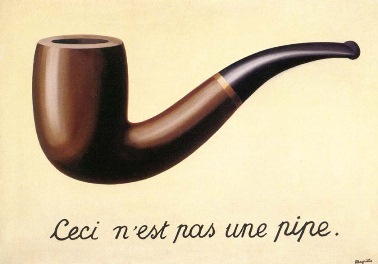
René Magritte, The Treachery of Images (This Is Not a Pipe), 1929. Los Angeles County Museum of Art. View at LACMA
But I have a new contender for the most absurd and most canonical art joke ever made. Marcel Duchamp took a cheap postcard reproduction of the Mona Lisa and drew a mustache and a little goatee on her. That alone is funny, defacing the most worshipped painting on earth with a doodle. But the title is the better joke. He called it “L.H.O.O.Q.” Read those five letters aloud in French and they spell out the phrase “elle a chaud au cul,” which translates as “she has a hot ass.” He vandalized the most famous face in art and catcalled her. It’s one of the most important works.
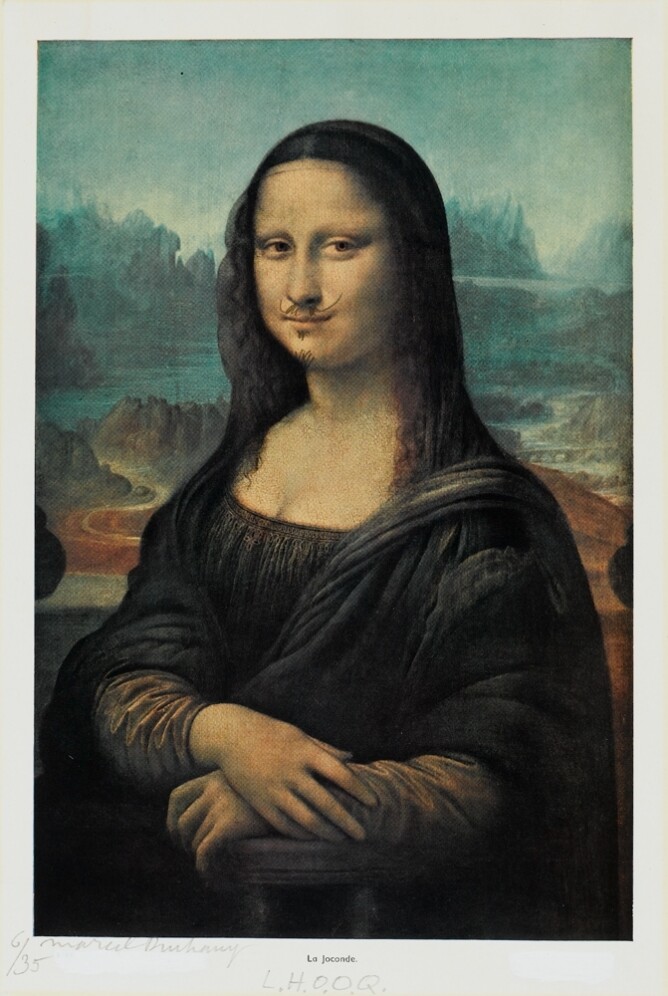
Marcel Duchamp, L.H.O.O.Q., 1919.
View at the Norton Simon Museum
Truly good conceptual art is often funny because it’s creating an entirely different point of view. A good joke pokes at something we take for granted and holds it up at a strange angle. The idea of art, what counts as art and what does not, is not something we normally examine. We just walk into a museum and assume the question is settled. Humor is one of the few tools sharp enough to pry it back open.
I went to the Duchamp show at the MoMA recently and spent most of it laughing, which is something that doesn’t normally happen at this museum. Museums, especially a place like MoMA, are about learning and being serious. They are not really set up for fun. Duchamp gave me fun anyway, and the more I looked the more I understood that he was one of the cleverest minds the art world has ever produced, a genuinely brilliant artist in a way that most artists, even very good ones, simply are not.
There is a photo from this trip I am going to use in my holiday letter. It is my mother-in-law Jeanne and me, standing in front of a urinal and smiling broadly. But this wasn’t any urinal. This was THE urinal. Duchamp’s Fountain, the porcelain one he bought in 1917, tipped onto its back, signed with the fake name “R. Mutt,” and submitted to an art exhibition as a sculpture.
Here is the thing. I never actually knew much about Duchamp. I knew about the urinal, of course. Everybody knows about the urinal. But I did not know much else, and what surprised me first was the most basic fact of all. Duchamp could really paint. As a teenager he made the kind of careful, pretty pictures that get a fifteen-year-old praised by his teachers. By his twenties he was deep into Cubism, and then he painted “Nude Descending a Staircase,” which scandalized people who showed up expecting a nude and got what looked like a robot falling down some stairs. He could have spent forty years being a respected painter. Instead he put the brush down and started asking a much deeper question about art. What if the idea is the art, and the object is almost beside the point?
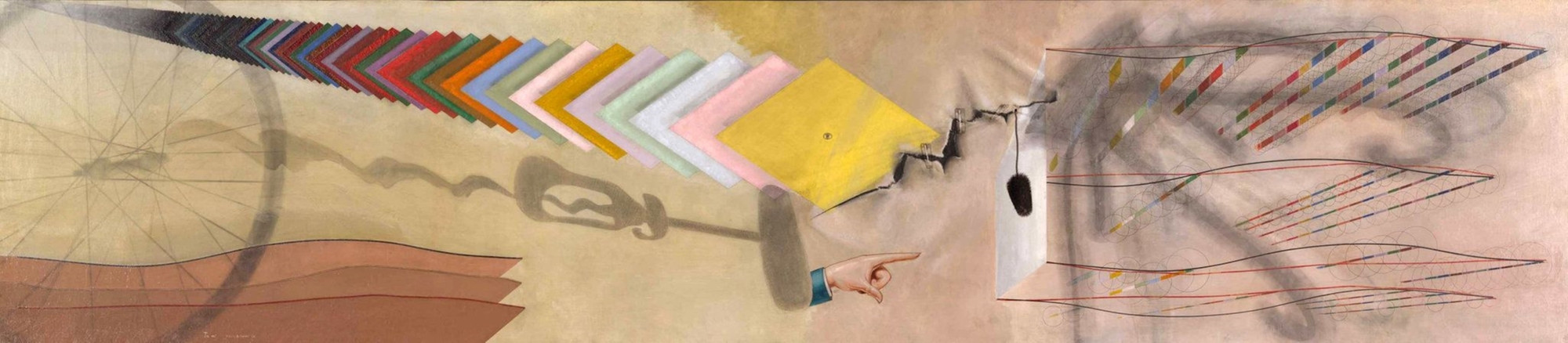
You can see him chewing on that question even in the paintings. His last painting on canvas is a long, strange picture with a painted tear running down it, and over the tear he stuck real safety pins, as if the canvas had ripped and somebody had mended it with whatever was in the kitchen drawer. He also brought in a commercial sign painter to add a pointing hand, and then had the sign painter sign that part of the work. So the painting is partly painted by a hired tradesman who gets his own credit on the canvas. It is a painting that quietly mocks the idea of the painting, and it already has the readymade idea hiding inside it.

Marcel Duchamp, Tu m’, 1918.
Image from Moma of Painting from Yale University Art Gallery
That idea ran through everything he did next. He would take an ordinary manufactured thing, a snow shovel, a bottle rack, a urinal, give it a title, and declare it art. No carving, no painting, no technique. The work was the decision. You can feel the establishment recoiling, and you can almost hear him asking, sweetly, “why not?” If you stand in front of Fountain and find yourself saying “that is not art,” congratulations, you’re participating in the conversation that Duchamp wants to have with you.
And that was the plan from the start. When he submitted “Fountain” in 1917, it went to an exhibition that had promised to show every work that was entered, no jury, no rejections. They rejected it anyway. They hid it during the show and refused to display it, which is precisely the reaction Duchamp was fishing for. He had not made a urinal beautiful. He had set a trap. He wanted the gatekeepers to look at an ordinary object he had chosen and called art, and to blurt out “no, that is not art,” so that everyone would suddenly have to ask the question out loud. What is art? Who decides? The rejection did not ruin the piece. The rejection completed it.
Including these readymades in the MoMA show was difficult. The show has a whole room of them, and almost none of them are originals. They are copies, replicas Duchamp authorized decades later. The reason is simple and a little wonderful. When he first made these things he was an impudent young man, around thirty, and nobody thought any of it mattered, including the people closest to him. The original Fountain was lost. The first bottle rack and bicycle wheel got thrown out, in some cases by his own family doing the sensible thing with what looked like junk. So the artworks that detonated the twentieth century survive mostly as second and third versions, made later, once the world had decided the joke was important after all. There is something perfect about that. The objects weren’t the point, the ideas were.
He kept finding new ways to create transgressive art. He invented an alter ego, a woman named Rrose Sélavy, and had the famous photographer Man Ray take pictures of him in character. The name is a pun. Say it in French and it sounds like “Eros, c’est la vie,” love is life. So the joke runs at least three layers deep, the costume, the name, and the wordplay hiding inside the name, and he is doing all of it with a completely straight face.
When he was escaping from Europe from the war he created the most beautiful miniature copies of his art. For his museum in a box project, he made little suitcases packed with tiny reproductions of his own work, a portable one-man retrospective you could carry around like a salesman’s sample case. And the miniatures are genuinely beautiful, made with real care. The audacity is the timing. He was assembling his own retrospective before he had really had the exhibitions that would earn one. He was curating his own legacy as a joke and as a fact in the same gesture.
When we look at someone like Duchamp now, we tend to see him through the people who came after, the ones who took his moves and turned them into a familiar, almost ordinary kind of art. Stand in front of a urinal in a gallery and it is easy to think of Andy Warhol and the soup cans. But Warhol never makes the soup cans without Duchamp going first. The imitators arrive and copy the discovery so many times that many of us never fully understand it. What was once revolutionary becomes wallpaper.
Jeanette Winterson, in her book Art Objects, writes that “The most conservative and least interested person will probably tell you that he or she likes Constable. But would our stalwart have liked Constable in 1824 when he exhibited at the Paris Salon and caused a riot? . . . To the average eye, now, Constable is a pretty landscape painter, not a revolutionary who daubed bright color against bright color ungraded by chiaroscuro. We have had 150 years to get used to the man who turned his back on the studio picture, took his easel outdoors and painted in a rapture of light. It is easy to copy Constable. It was not easy to be Constable.”
Duchamp was a real philosopher of art, sitting alongside the other brilliant minds who have changed how we see, and he did his philosophy through transgression. Plenty of people are funny. Cartoonists are funny, comedians are funny, the person who first drew a mustache on a poster was funny. Duchamp went much further than funny. He used the joke the way a philosopher uses a thought experiment, to corner you into a question you cannot wriggle out of. When Wittgenstein asks what we really mean by a word, or Descartes asks how he can be sure he is not dreaming, the move is the same one Duchamp makes when he sets a urinal on a pedestal. Each of them takes something you thought was obvious and shows you that you never actually examined it. The urinal is an argument. So is the mustache. He just made his arguments out of porcelain and pencil instead of prose.
That is the heart of it, I think. Art is supposed to surprise you and then make you think, and Duchamp understood that a good joke does both at once, faster than any sermon. He spent a whole career proving that the most serious idea in the room can walk in wearing a clown nose. Jeanne and I have the photo to prove we fell for it, grinning in front of the most famous toilet in the world.
Note: What a Joke! Marcel Duchamp’s Funny Fountain and its Complete Reversal of Art (which I haven’t read yet) seem similar to this, and another one, which talks about a Philadelphia exhibition that’s apparently not a joke ‘Fountain’ springs eternal as joke on art world.
Discover more from Rob Schlaff's Website
Subscribe to get the latest posts sent to your email.