Categories
Design Humor

Marcel Duchamp, the Funniest Man in the Museum

I have always liked art that made me laugh. For years my favorite art joke was René Magritte’s pipe, the painting of a perfectly ordinary pipe with the words “Ceci n’est pas une pipe” written underneath. This is not a pipe. And of course it is not. It is a painting of a pipe. You cannot smoke it. The joke is that the image of a thing is not the thing, and Magritte makes you laugh your way into a genuinely slippery idea about representation.
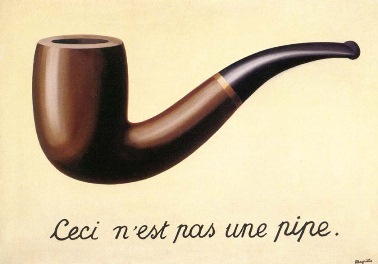
René Magritte, The Treachery of Images (This Is Not a Pipe), 1929. Los Angeles County Museum of Art. View at LACMA

But I have a new contender for the most absurd and most canonical art joke ever made. Marcel Duchamp took a cheap postcard reproduction of the Mona Lisa and drew a mustache and a little goatee on her. That alone is funny, defacing the most worshipped painting on earth with a doodle. But the title is the better joke. He called it “L.H.O.O.Q.” Read those five letters aloud in French and they spell out the phrase “elle a chaud au cul,” which translates as “she has a hot ass.” He vandalized the most famous face in art and catcalled her. It’s one of the most important works.
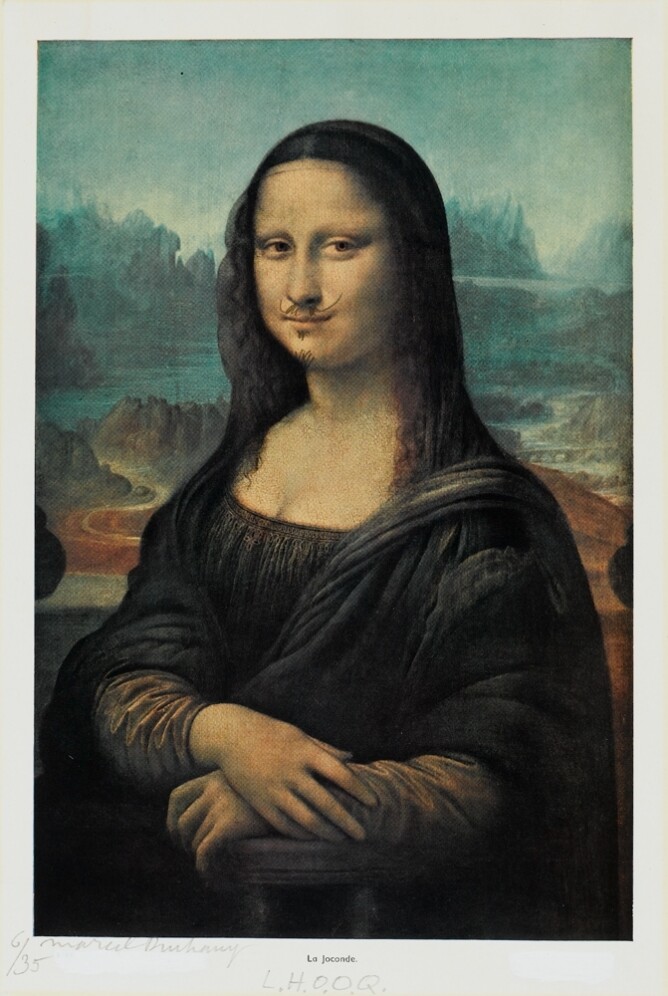
Marcel Duchamp, L.H.O.O.Q., 1919.
View at the Norton Simon Museum

Truly good conceptual art is often funny because it’s creating an entirely different point of view. A good joke pokes at something we take for granted and holds it up at a strange angle. The idea of art, what counts as art and what does not, is not something we normally examine. We just walk into a museum and assume the question is settled. Humor is one of the few tools sharp enough to pry it back open.

I went to the Duchamp show at the MoMA recently and spent most of it laughing, which is something that doesn’t normally happen at this museum. Museums, especially a place like MoMA, are about learning and being serious. They are not really set up for fun. Duchamp gave me fun anyway, and the more I looked the more I understood that he was one of the cleverest minds the art world has ever produced, a genuinely brilliant artist in a way that most artists, even very good ones, simply are not.

There is a photo from this trip I am going to use in my holiday letter. It is my mother-in-law Jeanne and me, standing in front of a urinal and smiling broadly. But this wasn’t any urinal. This was THE urinal. Duchamp’s Fountain, the porcelain one he bought in 1917, tipped onto its back, signed with the fake name “R. Mutt,” and submitted to an art exhibition as a sculpture.

Here is the thing. I never actually knew much about Duchamp. I knew about the urinal, of course. Everybody knows about the urinal. But I did not know much else, and what surprised me first was the most basic fact of all. Duchamp could really paint. As a teenager he made the kind of careful, pretty pictures that get a fifteen-year-old praised by his teachers. By his twenties he was deep into Cubism, and then he painted “Nude Descending a Staircase,” which scandalized people who showed up expecting a nude and got what looked like a robot falling down some stairs. He could have spent forty years being a respected painter. Instead he put the brush down and started asking a much deeper question about art. What if the idea is the art, and the object is almost beside the point?

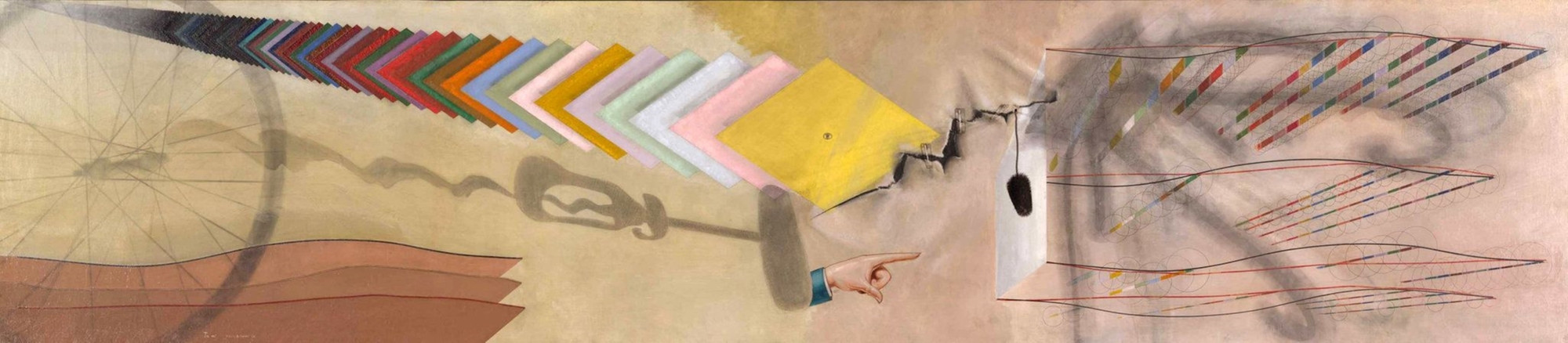
You can see him chewing on that question even in the paintings. His last painting on canvas is a long, strange picture with a painted tear running down it, and over the tear he stuck real safety pins, as if the canvas had ripped and somebody had mended it with whatever was in the kitchen drawer. He also brought in a commercial sign painter to add a pointing hand, and then had the sign painter sign that part of the work. So the painting is partly painted by a hired tradesman who gets his own credit on the canvas. It is a painting that quietly mocks the idea of the painting, and it already has the readymade idea hiding inside it.

Marcel Duchamp, Tu m’, 1918.
Image from Moma of Painting from Yale University Art Gallery

That idea ran through everything he did next. He would take an ordinary manufactured thing, a snow shovel, a bottle rack, a urinal, give it a title, and declare it art. No carving, no painting, no technique. The work was the decision. You can feel the establishment recoiling, and you can almost hear him asking, sweetly, “why not?” If you stand in front of Fountain and find yourself saying “that is not art,” congratulations, you’re participating in the conversation that Duchamp wants to have with you.

And that was the plan from the start. When he submitted “Fountain” in 1917, it went to an exhibition that had promised to show every work that was entered, no jury, no rejections. They rejected it anyway. They hid it during the show and refused to display it, which is precisely the reaction Duchamp was fishing for. He had not made a urinal beautiful. He had set a trap. He wanted the gatekeepers to look at an ordinary object he had chosen and called art, and to blurt out “no, that is not art,” so that everyone would suddenly have to ask the question out loud. What is art? Who decides? The rejection did not ruin the piece. The rejection completed it.

Including these readymades in the MoMA show was difficult. The show has a whole room of them, and almost none of them are originals. They are copies, replicas Duchamp authorized decades later. The reason is simple and a little wonderful. When he first made these things he was an impudent young man, around thirty, and nobody thought any of it mattered, including the people closest to him. The original Fountain was lost. The first bottle rack and bicycle wheel got thrown out, in some cases by his own family doing the sensible thing with what looked like junk. So the artworks that detonated the twentieth century survive mostly as second and third versions, made later, once the world had decided the joke was important after all. There is something perfect about that. The objects weren’t the point, the ideas were.

He kept finding new ways to create transgressive art. He invented an alter ego, a woman named Rrose Sélavy, and had the famous photographer Man Ray take pictures of him in character. The name is a pun. Say it in French and it sounds like “Eros, c’est la vie,” love is life. So the joke runs at least three layers deep, the costume, the name, and the wordplay hiding inside the name, and he is doing all of it with a completely straight face.

When he was escaping from Europe from the war he created the most beautiful miniature copies of his art. For his museum in a box project, he made little suitcases packed with tiny reproductions of his own work, a portable one-man retrospective you could carry around like a salesman’s sample case. And the miniatures are genuinely beautiful, made with real care. The audacity is the timing. He was assembling his own retrospective before he had really had the exhibitions that would earn one. He was curating his own legacy as a joke and as a fact in the same gesture.

When we look at someone like Duchamp now, we tend to see him through the people who came after, the ones who took his moves and turned them into a familiar, almost ordinary kind of art. Stand in front of a urinal in a gallery and it is easy to think of Andy Warhol and the soup cans. But Warhol never makes the soup cans without Duchamp going first. The imitators arrive and copy the discovery so many times that many of us never fully understand it. What was once revolutionary becomes wallpaper.

Jeanette Winterson, in her book Art Objects, writes that “The most conservative and least interested person will probably tell you that he or she likes Constable. But would our stalwart have liked Constable in 1824 when he exhibited at the Paris Salon and caused a riot? . . . To the average eye, now, Constable is a pretty landscape painter, not a revolutionary who daubed bright color against bright color ungraded by chiaroscuro. We have had 150 years to get used to the man who turned his back on the studio picture, took his easel outdoors and painted in a rapture of light. It is easy to copy Constable. It was not easy to be Constable.”

Duchamp was a real philosopher of art, sitting alongside the other brilliant minds who have changed how we see, and he did his philosophy through transgression. Plenty of people are funny. Cartoonists are funny, comedians are funny, the person who first drew a mustache on a poster was funny. Duchamp went much further than funny. He used the joke the way a philosopher uses a thought experiment, to corner you into a question you cannot wriggle out of. When Wittgenstein asks what we really mean by a word, or Descartes asks how he can be sure he is not dreaming, the move is the same one Duchamp makes when he sets a urinal on a pedestal. Each of them takes something you thought was obvious and shows you that you never actually examined it. The urinal is an argument. So is the mustache. He just made his arguments out of porcelain and pencil instead of prose.

That is the heart of it, I think. Art is supposed to surprise you and then make you think, and Duchamp understood that a good joke does both at once, faster than any sermon. He spent a whole career proving that the most serious idea in the room can walk in wearing a clown nose. Jeanne and I have the photo to prove we fell for it, grinning in front of the most famous toilet in the world.

Note: What a Joke! Marcel Duchamp’s Funny Fountain and its Complete Reversal of Art (which I haven’t read yet) seem similar to this, and another one, which talks about a Philadelphia exhibition that’s apparently not a joke ‘Fountain’ springs eternal as joke on art world.

Categories
Design Fun Stuff

Welcome to Buc-ee’s: The Disney World of Gas Stations

Welcome to Buc-ee’s, the world’s most magical gas station—a place where travelers from every corner of this great country find comfort, refreshment, and a moment of cheer along their journey. Here, the spirit of the open road lives on—in the laughter of families, the sparkle of spotless tile, and the scent of freshly carved hot brisket and homemade fudge. It’s dedicated to wanderers and wayfarers who believe that even the briefest stop can be touched by joy.

We visited our first Buc-ee’s on our summer trip to Knoxville on I-81 to see my Abigai’s parents. We pulled into the Mount Crawford location, Virginia’s first Buc-ee’s. The first thing we noticed was its sheer size. This place is massive—120 gas pumps and 74,000 square feet of retail space, making it one of the largest convenience stores in the world. Despite over 600 parking spots, finding a space still took a minute. It was packed.

When we opened the door, we were hit with a low roar—the sound of hundreds of people crammed into the store. It felt like arriving at Magic Kingdom for rope drop, except this was 1 PM on an average Sunday. And the smell: sticky-sweet Texas BBQ sauce hanging in the air, promised something far better than typical gas station fare.

After hours in the car, we made a beeline for the bathrooms. Even with the crowds, there was no line. The bathrooms are enormous, with 50+ individual stalls. They’re legendary for their cleanliness, winning Cintas’s “America’s Best Public Restroom” award. As founder Arch “Beaver” Aplin said, “You can build it out of gold…but if you don’t clean it, at the end of the day, you end up with dirty gold.”

Then there’s the food. I like to call it rest stop gourmet. We grabbed soft, melt-in-your-mouth brisket sandwiches. We also picked up homemade fudge and a few bags of beef jerky (from two dozen varieties) from the jerky wall, plus Buc-ee’s signature snack: Beaver Nuggets, caramel-covered puffed corn.

But Buc-ee’s is so much more than the food and bathrooms. The brand is half the magic. Long before you see the store, Buc-ee’s billboards appear miles out—each one mixing dad humor with road-trip poetry: “Top Two Reasons to Stop at Buc-ee’s: #1 and #2” or “You Can Hold It… 262 Miles More!” By the time you pull off the highway, you already feel like part of the club.

Inside, that cartoon beaver grins from every shelf, turning ordinary merchandise into part of the experience. My teenage son bought a Buc-ee’s onesie to wear for Halloween—part joke, part personal brand building. That’s the power of Buc-ee’s: they’ve made a gas station mascot cool enough that a teenager will willingly wear it as a costume.

The Buc-ee’s Onesie

The souvenir shop rivals any tourist destination—like Cracker Barrel on steroids, selling Buc-ee’s branded and Texas-themed merchandise. We picked up tote bags and even a Buc-ee’s outdoor sofa. We wanted to continue the Buc-ee’s experience even after we went home.

But where did this magical place called Buc-ee’s come from? Founded in 1982 by Arch “Beaver” Aplin III (his nickname stemming from childhood and a quirky toothpaste-cartoon beaver mascot) and partner Don Wasek, Buc-ee’s began as a simple convenience store and gas station in Lake Jackson, Texas, with a goal of providing “clean, friendly, in-stock” service that would stand out. In 2003, it opened its first true “super-travel center” in Luling, Texas. By 2012, it had erected a 68,000-square-foot store in New Braunfels, widely deemed “the world’s largest convenience store” at the time.

After dominating Texas for decades, Buc-ee’s began expanding beyond its home state around 2018–19, starting with Alabama, then Florida, Georgia, and Tennessee.

Even with all of this brand equity, Buc-ee’s doesn’t have its own online store. That doesn’t mean you can’t buy Buc-ee’s merch online, though. In true Texas-sized entrepreneurial fashion, one fan, Chris Koerner, saw the gap and filled it. When he realized there was no way to order Beaver Nuggets or a Buc-ee’s hoodie from home, he loaded six shopping carts with every Buc-ee’s branded product he could find—650 items in all—and built an unofficial resale site called Texas Snax. Today, his company ships everything from jerky to plush beavers across the country, doing hundreds of thousands of dollars in sales each month. Buc-ee’s, for its part, doesn’t object—as long as he makes it clear that he’s independent from the company.

What Buc-ee’s understands—and what so many businesses miss—is that people don’t just want a transaction. They want an experience, even in the most unlikely places. Especially in unlikely places. In the middle of a long highway stretch, when you’re tired and restless, Buc-ee’s transforms a mundane pit stop into something worth talking about, worth remembering, worth taking home. That’s not just good business. That’s magic.

Note: The New York Times wrote a nice piece on Buc-ee’s earlier in the summer Buc-ee’s, a Pit Stop to Refuel Cars, Stomachs and Souls, Spreads Beyond Texas.

Categories
Design Humor

Luna Luna: When the Art World Ran Away with the Circus

Sometimes, an idea is so good that everyone around can’t help but pitch in. Take the story of stone soup, a folktale about a traveler who convinces an entire village to create a feast out of nothing but a stone and a pot of water. It begins with skepticism, but with a little charm and some shared curiosity, the villagers contribute their carrots, onions, and spices. What starts as a trick becomes a celebration, a collaborative act of creation.

Categories
Design

Is Great Design Hiding in Your Living Room?

Walking through the Metropolitan Museum of Art, we pass the Temple of Dendur, rescued by Jackie Kennedy before Lake Nasser was flooded after the Aswan Dam was built. Then it’s off to European art to see Picassos and Renoirs. Then we go downstairs to the Design Collection to see… my dining room chair?

That’s the funny thing about design collections. Iconic designs from the past have blended so seamlessly into modern life that we forget their origins. It’s like realizing the guy in the hoodie at the coffee shop is a tech CEO. What was once groundbreaking has become… ordinary.

Categories
Design Technology

When More is Less: David Pogue on the Pitfalls of Feature Creep

I really love David Pogue. He is a brilliant Renaissance man who talks about technology but from a very cultivated point of view. I don’t just say that because he went to Yale. I always enjoy the way he makes technology accessible and engaging, offering insights that resonate with both tech enthusiasts and everyday users.

Categories
Design Uncategorized

How a Small Fly Became a Big Deal in Bathroom Hygiene

Have you noticed the fly that lives in the urinal? In many urinals, a fly has been etched or printed near the drain as a target. This clever addition is a simple image of a fly that serves an important purpose. The idea is to provide a target to aim at, reducing spillage and keeping restrooms cleaner.

Categories
Design

Yale Architecture: Disney Collegiate?

When I visit Yale, I’m immediately inspired by the architecture. As an undergraduate, I couldn’t believe that this was my home. The intricate details of the Gothic and Georgian buildings, with their soaring arches and ornate facades, made me feel like I was traveling through history. Walking through the courtyards and along the pathways, I am constantly reminded of the generations of scholars who have walked these same paths before me.

Categories
Design

Thomas Heatherwick, Designer and Master Builder

Great design combines a strong artistic vision with the fulfillment of a real-world need. Thomas Heatherwick, the builder behind the Vessel, exemplifies great design. The first time I saw the Vessel, I was biking along the West Side Highway and saw this wonderful staircase being built. Two things went through my head at the same time: “This staircase would be amazing to climb” and “There’s no way that I’ll be able to climb it because it’s going to be part of some new building.” When I learned that this was going to be an interactive sculpture that you can walk through, I had another two thoughts: “This is so amazing! I’m going to be able to climb those stairs!” and “What kind of person would spend $200 million on a bunch of stairs?!”

Categories
Building Design Fun Stuff Life Lessons

My Personal Contact Cards

I created this card around 2015. I wanted to show my creativity off when I met someone, rather than just tell them where I worked. I wanted to own my own personal brand.

I came across these cards from Apple online. The card read, “Your customer service just now was exceptional. I work for the Apple Store and you’re exactly the kind of person we’d like to talk to. If you’re happy where you are, I’d never ask you to leave. But if you’re thinking about a change, give me a call. This could be the start of something great.”

I loved the sentiment, so I borrowed it for my own cards and made this:

But where did I get the idea of a personal card in the first place?

It was the summer of 1999 and Merrill Ford gave me her calling card at the International Design Conference at Aspen (IDCA). The IDCA was the forerunner to TED—Richard Saul Wurman wanted to head the IDCA, but they didn’t let him, so he went off and started TED instead.

A calling card is different from a business card, slightly larger and with different dimensions. People used to leave it at a house when visiting someone who wasn’t home, a small note that you’d called.

My team had won the student design competition by creating a pen that transcribes what you write, and we were presenting our idea. These are pretty typical now, but they were a novel concept in 1999.

I was walking down the street with my friend Jeremy when we were stopped by three older people. “What are you doing walking!” they said. “You should come to lunch with us.”

So we went.

We started talking. Merrill gave me her calling card. The naïve 21-year-old I was, asked “Do you ski?”

I didn’t realize how silly a question it was at the time. I didn’t have Google then, and it took me years to realize that I was being taken out to lunch by some of the founding members of the Aspen community.

Merrill said, “Of course, but not since the injury.”

She walked with a cane, but not because she was old. She’d been one of the first Obermeyer ski models. Merrill had been married to Stein Eriksen, one of the most famous skiers. But she was in a horrible car crash in 1973 and since then, walked with a cane.

Merrill was sitting next to her boyfriend, Major General Robert Taylor, who everyone called “The General.”

Merrill would tease that people asked when she and The General were going to get married. “When I get pregnant,” Merrill would say. She was in her early 70s at the time. They eventually married in 2001.

Merrill Ford as an Obermeyer Model (from her Obituary in the Aspen Times)

The General said, “I came out to Aspen to ski. I’d learned to love the sport when I was in Europe in World War II. But now that I’m 85, my knees can’t take it anymore.”

Then we got to Ruthie. She said, “No. I don’t ski much.”

Then Merrill teased Ruthie: “Oh come on Ruthie. They named the second run on the mountain after you.”

It’s true! The third member of their group was Ruth Brown. The first run on the mountain was Roch Run. It was cut by volunteers in 1937 and was steep and difficult—the only other option was a sideslip down Spar Gulch. A decade later, that was still the only way down. But, as Ruthie told the Aspen Times, “To be perfectly frank, I was never a great, fabulous skier. All I did was just go down and have fun. I wanted to get down the mountain.” So she gave $5,000 to the Aspen Skiing Corporation to cut a kinder, gentler way down in the summer of 1948. Ruthie’s Run opened on December 16, 1948, with Ruthie leading the way, snowplowing down through 3 feet of powder.

That’s why I made my own cards in 2015. Not to show off where I worked, but because Merrill Ford taught me that the best cards say “I’d like to know you better.”

They’ve all passed on now. The general in 2003, Merrill and Ruthie both in 2010, just two months apart. I still have Merrill’s calling card. And at Aspen, Ruthie’s Run is still the kinder, gentler way down the mountain.

What amazes me is how casually they invited us in. They were founders of Aspen, married to Olympic champions, had ski runs named after them. And they treated two college kids like we belonged at their table.

Categories
Design

Pictures at Weddings OR Experience the Moment Don’t Capture It

I just left a wedding and I saw the most amazing thing. The bride and groom made sure that people were not going to take pictures during the wedding. It’s mixing enormous amount of sense because:

  1.  They will be taking the world’s worst pictures of the bride and groom.
  2.  It’s also distracting to everyone who sits there.
  3. They aren’t really even experiencing the wedding there just spending a lot of time figuring out how to take the best picture.
  4. The bride and groom have hired a professional photographer


This also reminds me of a picture of how people change in the way that they experience life due to mobile phones. When the pope was chosen in 2005 everybody was there actively awaiting the decision. Also it must have been pretty a pretty wonderful experience. Everyone was probably talking to other and being in the moment and just having this wonderful communal excitement. In 2013 when the pope is chosen everybody had their mobile phones out my does it take a picture to post on Facebook. It feels like that moment was memorialized better but at what cost?